
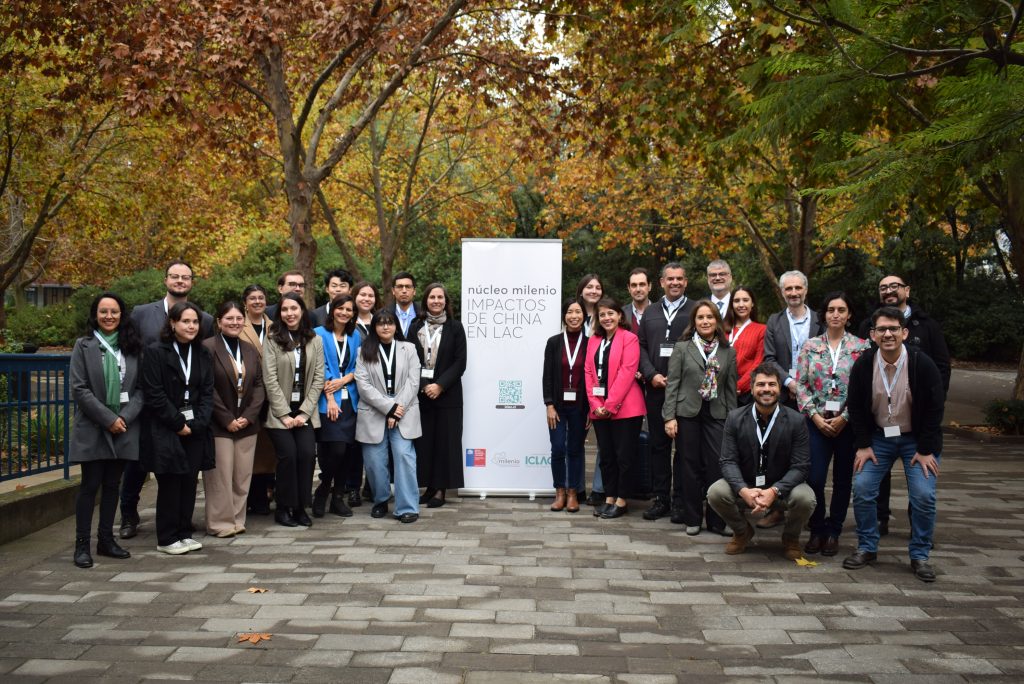
On May 20, Millennium Nucleus ICLAC held a key meeting with representatives of the ANID Millennium team to show the nucleus's advances and achievements in these more than two years of work, as well as its future projections. The activity is part of the follow-up to the nuclei funded by the Millennium Scientific Initiative.
The visit featured participation from Mauricio Maldonado, head of the Millennium Department and Frontier Scientific Initiatives of ANID, and Carla Rojas, the Center's executive from the same department. Additionally, all ICLAC principal investigators, associate researchers, thesis students, visiting researchers, young researchers and research assistants participated, along with the management team.
During the presentation, nucleus director Francisco Urdinez highlighted the team's structure and work, emphasizing its interdisciplinary composition that addresses the complexity of China's impacts in the region from diverse approaches, such as political science, geography, economics, history, communications, and international relations, among others.
In his intervention, Urdinez emphasized that one of the center's greatest contributions has been generating unprecedented data on China-Latin America relations. "When we started, there was no data. We didn't know where Chinese companies were, or how Chileans perceived that relationship," he noted. The nucleus's two research lines focus, on one hand, on mapping Chinese actors in LAC and their strategies, and on the other, on analyzing subnational impacts of Chinese trade and investments.
For his part, Johannes Rehner, principal investigator, presented key products such as the Regional Repository of Chinese Investments in Latin America, a georeferenced platform that already covers eight countries and has awakened great academic and governmental interest. Another highlighted instrument is the Public Opinion Monitor "What do Chileans think about China?", which, in three rounds, has captured citizen perception.
Advanced human capital formation is another fundamental pillar. Catalina Leiva, nucleus thesis student, detailed that ICLAC has trained 39 young researchers in different modalities, including 18 under tutelage in projects, 9 interns, and 12 visiting researchers, with important female participation (23 women). The nucleus has also facilitated professional internships, thesis supervision, and access to graduate scholarships.
Public impact and community engagement
In the area of community engagement, Carol Chan, the new alternate director, underscored ICLAC's active role in public conversation about China. Through Millennium PME projects, such as the documentary "The Journey of Guan Gong" about Chinese migration and the workshops "Getting to Know China from Chile" in regional schools, the nucleus has led various instances of discussion and reflection. Additionally, the free online course "Impacts of China in Latin America and the Caribbean" already has more than 500 participants from throughout Latin America.
Finally, principal investigator Claudia Labarca presented advances in media visibility and social networks, highlighting ICLAC's broad presence in national and international media, in addition to creating a robust community through digital platforms. "ICLAC is forming itself as an opinion leader, as a legitimate spokesperson (...) to account for its knowledge in public opinion," she affirmed. Regarding the formation of an international collaboration network, links generated with centers in Asia, Europe, Africa, and America stand out, including future collaborations with Oxford, Nairobi, and Sydney.
In the final part of the day, a participatory SWOT analysis was developed, with presentations by Álvaro Guerrero, in charge of Management and Networks, and ICLAC director Francisco Urdinez, generating a feedback space with ANID and all participants.