
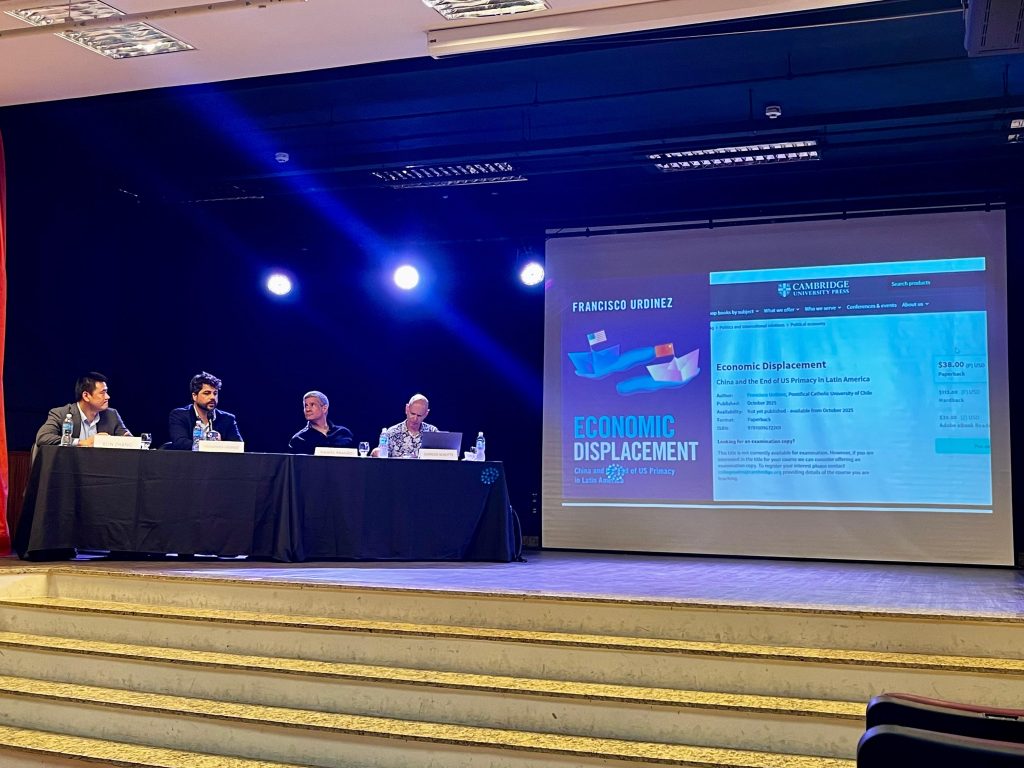
Between September 22nd and 24th, the director of the Millennium Nucleus ICLAC, Francisco Urdinez, participated in the international seminar "South-South Cooperation: 70 Years After Bandung", held at the Federal University of Bahia (UFBA), Brazil. At the event, the academic presented his research on the economic displacement of the United States by China in Latin America.
The seminar aimed to commemorate the 70th anniversary of the Bandung Conference, a milestone that laid the foundations for the Non-Aligned Movement, and to debate its principles in the 21st century. The discussion focused on the current challenges in economic, political, and diplomatic cooperation among countries that constitute the Global South.
Urdinez's presentation, titled "Economic Displacement: China and the Decline of American Primacy in Latin America", took place on the panel "Sino-Latin American Relations in the 21st Century" and addressed the central findings of his book published by Cambridge University Press.
"The concept of 'economic displacement' explains how this change is not simply the sum of more Chinese trade and investment, but a structural substitution that has concrete political consequences", the academic explained. "This substitution erodes American soft power and reduces the effectiveness of its economic incentives to exert political influence in the region".
During his presentation, Urdinez presented empirical evidence demonstrating how, in countries where this shift has occurred, both public opinion and political elites have modified their perceptions of China's ability to resolve regional issues compared to that of the United States.
South-South Cooperation in a New Global Scenario
When asked about the current relevance of the "Spirit of Bandung" for relations between Latin America and China, the ICLAC director noted that South-South cooperation today has "renewed relevance, but is also more complex".
According to Urdinez, China's rise has created significant asymmetries within the Global South that did not exist in 1955. "China is no longer simply another developing country, but a power with financing, investment, and trade capacity that rivals countries in the Global North", he stated.
In this sense, his research shows that Latin American countries do not perceive China through ideological lenses or South-South solidarity, but pragmatically: as a partner that offers concrete development opportunities.
"Contemporary South-South cooperation with China differs from the spirit of Bandung because it involves relationships with enormous power asymmetries. The current challenge for Latin American countries is how to carefully navigate between maintaining strategic autonomy and taking advantage of the economic benefits this relationship offers", Urdinez concluded.
The event was organized by the Federal University of Bahia, Shanghai University, the UFBA Graduate Program in International Relations, and the Confucius Institute at the same institution.