
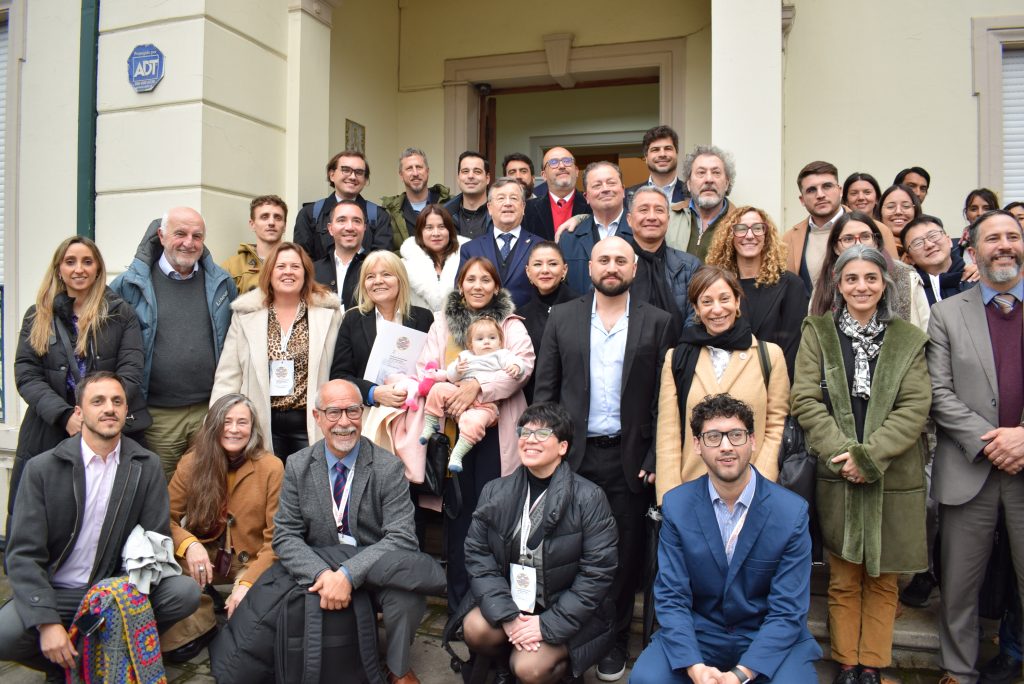
To analyze China's role in the changing global landscape and strengthen academic cooperation, the 2nd Congress of Latin American Sinologists 2025 was held in Santiago from July 31st to August 2nd. The meeting, co-organized by the World Center of Sinology and the University of Chile, Andrés Bello University, and the University of Santiago, brought together prominent academics and professionals to debate the construction of a "community of shared future between China and Latin America".
The Millennium Nucleus on China's Impacts in Latin America and the Caribbean (ICLAC), as one of the event's collaborating institutions, it had a leading participation in different thematic tables, contributing with rigorous data and analysis to the congress discussions.
Cultural Dialogues
The first day of the congress included the panel "Dialogue and transcultural exchanges between Chinese and Latin American civilizations". In this space, ICLAC researcher María Elvira Ríos presented on "Chinese malls", a growing phenomenon in Chile. Based on workshops conducted by ICLAC in different regions of the country, she addressed how local perceptions oscillate between economic valuation and cultural distance, proposing Chinese language teaching as a bridge for integration.
For his part, researcher José Miguel Vidal, academic of the UC Interdisciplinary Program of Religious Studies, in his presentation "A stay of encounters and disagreements: the experience of the Pablo de Rokhas in the People's Republic of China", revealed the complexities of early cultural diplomacy. Based on an unpublished Chinese official archive, he reconstructed the poet's visit in 1964, showing both his ideological affinity with Maoism and the everyday problems of the trip.
Geopolitics, Economy, and Environment
On the second day, held at the Institute of International Studies of the University of Chile, the table "South-South Geopolitics: Latin American perspectives on China and the emerging world order" was held. In this panel, ICLAC director and UC Institute of Political Science academic, Francisco Urdinez, presented the central arguments of his upcoming book. He explained that China's growing presence in South America is due to an American retraction that has generated greater agency margin for the region's countries.
In the same panel, the IEI academic, Juan Enrique Serrano, offered a critical analysis of the concept of "ecological civilization". He argued that this narrative functions as a "technological arrangement" that consolidates China's industrial leadership in green technologies, which poses new challenges and opportunities for Latin America.
The table also featured the presentation by Renzo Burotto, ICLAC thesis student and IEI master's student, titled "South-South Cooperation? The Trump Effect and the reconfiguration of the international order", and was moderated by researcher and also IEI academic, Andrés Bórquez.