
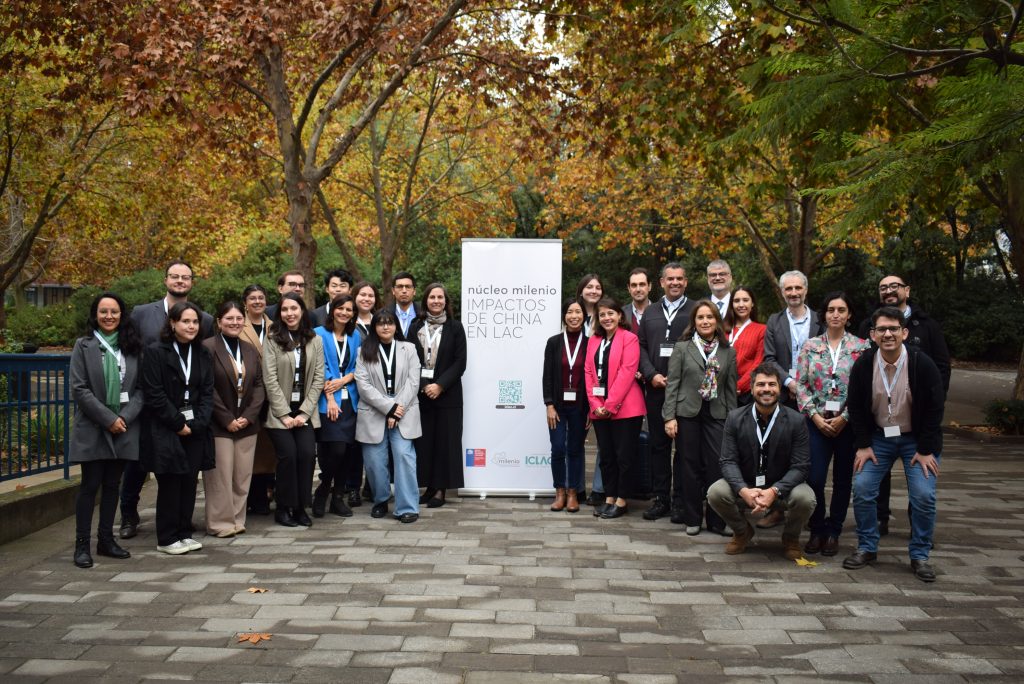
The The Millennium Nucleus for the Study of China's Impacts in Latin America and the Caribbean (ICLAC) has been awarded the renewal of its funding for the period 2026-2028. This award, granted by the Millennium Science Initiative of the National Research and Development Agency (ANID), validates the excellence of the work carried out in its first period and ensures three more years of continuity to strengthen its research, training, and community engagement activities.
ICLAC's main objective is to deepen understanding of China's localized and multidimensional impact on Chile and the region, examining its socioeconomic, political, and cultural dimensions to inform evidence-based policies.
Francisco Urdinez, ICLAC director and professor at the UC Institute of Political Science, valued the renewal as a key milestone, especially in the current global context: "ICLAC's renewal for three more years represents recognition of the relevance and quality of the work carried out, but also a greater responsibility at a crucial moment. In the current global context, marked by the reconfiguration of geopolitical relations and the growing strategic importance of Sino-Latin American relations, having a specialized center that generates rigorous and evidence-based knowledge is fundamental", he emphasized.
The director also noted that this continuity "allows us to consolidate our role as a regional reference in the analysis of dynamics between Latin America and China, providing data and analysis that are increasingly necessary for informed decision-making in both the public and private sectors".
Consolidation of a Period of Achievements (2023-2025)
In its first years of operation, ICLAC consolidated a research and dissemination agenda recognized for its impact. Among its main achievements is the creation of pioneering data infrastructure, such as the Regional Repository of Chinese Investments, the first georeferenced database on more than 300 Chinese investments in Latin America, and the implementation of the Monitor of Public Opinion Survey on Chile-China Relations, the first systematic survey in Chile that measures citizens' perceptions of China in different regions.
This is complemented by active scientific production in high-impact journals, as well as Case Reports and Policy Papers on strategic sectors such as lithium, cherries, the salmon industry, and "Chinese malls". In the area of training and community engagement, the nucleus designed the free online course "China's Impacts in Latin America", conducted specialized courses for diplomatic personnel, and created the short documentary "The Journey of Guan Gong", and delivered the workshops "Getting to know China from Chile" in the regions of Arica and Parinacota, Antofagasta, and Ñuble, as well as virtually open to the general public.
New Stage: Research Expansion (2026-2028)
This renewal not only provides continuity to the work but also marks a strategic evolution. The Millennium Nucleus ICLAC will expand its research structure to address the complexity of the current scenario in greater depth.
While the first period (2023-2025) focused on the lines "Mapping the Chinese Actors in LAC and their strategies" and "Subnational impacts of China's trade and investment", the new triennium will focus on three renewed research lines:
- International Relations and China's Political Influence in Latin America
- Economic and Territorial Impacts of China's Investment and Trade
- Cultural Perceptions, Identity Formation, and Social Adaptation to Chinese Engagement
Carol Chan, alternate director of ICLAC and professor at the School of Anthropology at Diego Portales University, explained how this new organization will enhance the nucleus's work: "In the next three years, the new organization will be divided into three research lines will allow us to deepen cultural, economic, and political analysis, and facilitate work around these approaches within research groups. At the same time, it will favor dialogue and interdisciplinary work, allowing us to highlight more clearly the multidimensional and multiscalar impacts of 'China' in the country and the region."