
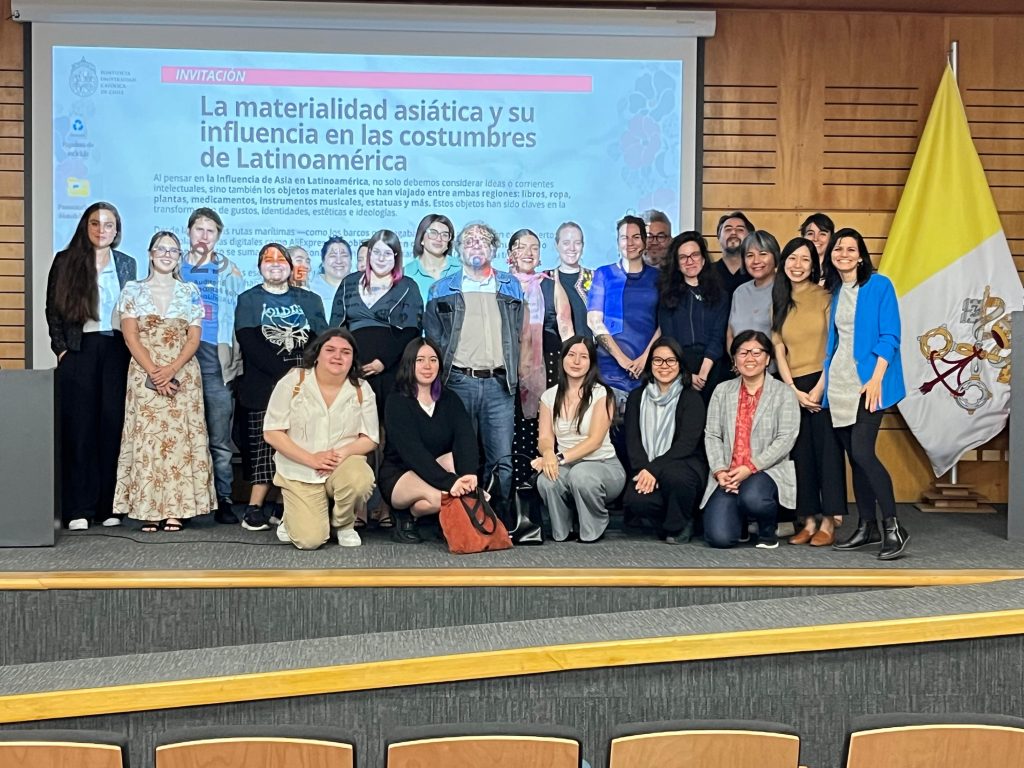
On October 29th, the seminar "Asian Materiality and Its Influence on Latin American Customs" was held at the Auditorium of the Faculty of History, Geography and Political Science at the Pontifical Catholic University of Chile. The event was organized by the UC Center for Asian Studies (CEUC), together with the Millennium Nucleus ICLAC, the Center for Intercultural and Indigenous Studies (CIIR), and the National Historical Museum.
The session aimed to reflect on how various material objects have historically connected Asia and Latin America. The presentations covered a broad spectrum, ranging from the historical influence of the Silk Road and Chinese textiles to the contemporary impact of phenomena such as "Chinese malls" in rural areas, K-beauty, and popular culture associated with K-pop, including photocard collecting.
The seminar began with opening remarks from the director of ICLAC and CEUC, Francisco Urdinez; the dean of the UC Faculty of History, Geography and Political Science, Valeria Palanza ; and the director of CIIR, Pedro Mege. The activity was structured into seven discussion panels that addressed visual art, religion, literature, fashion, and popular culture. Among the topics discussed were the Japanese Kintsugi technique in Argentina, the role of Chinese diplomatic gifts, and the legacy of religious objects such as the Okinawan Butsudan.
The event included the participation of ICLAC researchers. Principal researcher Patricia Palma
presented the paper "Chinese Herbs and Roots: The Development and Control of Chinese Medicine in Latin America (1850-1930)" at the panel dedicated to the migrant body as a transmitter of cultural practices. María Elvira Ríos spoke about María Elvira Ríos presented on "Objects in Everyday Life: Chinese Malls and Their Impact in Rural Areas of Ñuble" at the panel on popular culture objects, as a postdoctoral researcher Jessica Sequeira presented the paper "Guzheng, Pipa, Liuqin: Chinese String Instruments in Chile and Their Poetic Mobilities“.