
On Tuesday, November 25, the keynote lecture "China's Global Port Expansion: Investment, Infrastructure, and Power Projection", given by academic Wendy Leutert and organized by the Millennium Nucleus ICLACin collaboration with the UC Center for Asian Studies and the UC Institute of Political Science, was held.
Leutert, a professor at Indiana University and expert in state-owned enterprise reform, presented the findings of her research, in which she proposes the concept of “Portfolio Power Projection” to explain how Beijing exerts international influence. Unlike other powers that rely on military bases, China has established a commercial network of 96 ports across 53 countries, primarily managed by three large conglomerates: COSCO Shipping, China Merchants Port, and Hutchison Ports.
During her presentation, the researcher highlighted the strategic shift of these companies, which have transitioned from being simple construction contractors to becoming long-term operators and investors. When asked whether this expansion serves commercial or security purposes, Leutert was emphatic: "We're often asked if this is economic or strategic. We conclude that economics is strategic. When you have a large enough economic interest, it inevitably becomes a strategic interest". This network allows dual functions, facilitating trade in peacetime but also enabling naval logistical support and protection of citizens abroad in the event of crises.
Seminar with ICLAC Researchers
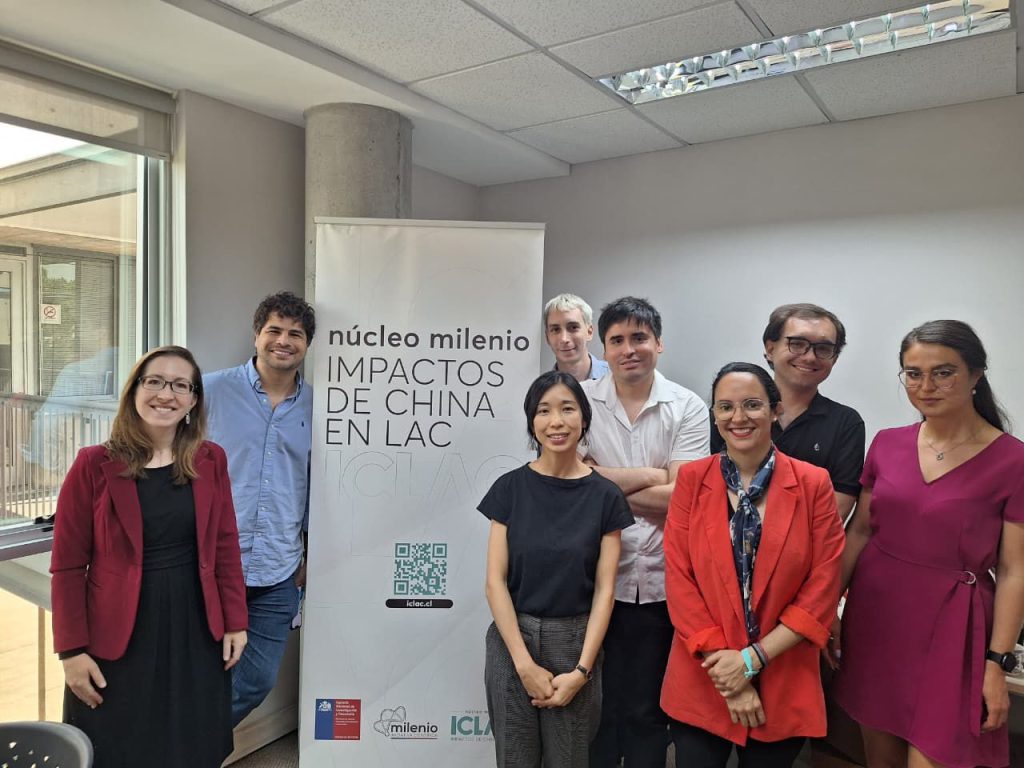
After the keynote lecture, Wendy Leutert's visit continued with a working session at the Millennium Nucleus ICLAC office. There she was received by our alternate director, Carol Chan, along with a group of researchers, to exchange ideas and analyze the implications of these findings specifically for Latin America. The academic's agenda in Chile also included a presentation at the UC Institute of Political Science on November 26.