
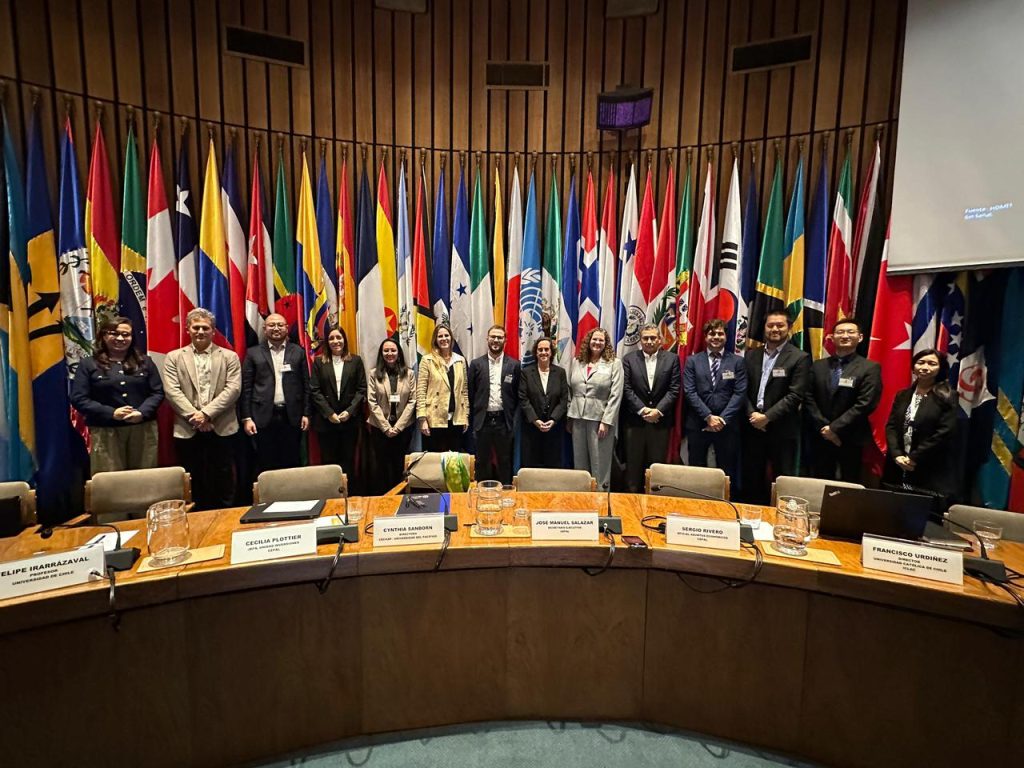
To promote high-level dialogue on the reconfiguration of the international economy and the role of major powers in the climate crisis, the International Seminar "Latin America, China and the New Climate Economy: Opportunities and Challenges for a Just Transition"was held. The event was co-organized by the Center for Studies on China and the Asia-Pacific (CECHAP) at Universidad del Pacífico (Peru) and the Millennium Nucleus on the Impacts of China in Latin America and the Caribbean (ICLAC), in collaboration with the Global Development Policy Center at Boston University..
The event, held in hybrid format on April 24 from the premises of the Economic Commission for Latin America and the Caribbean (ECLAC), featured the participation of distinguished scholars. Opening remarks were delivered by José Manuel Salazar, Executive Secretary of ECLAC, who offered a broad perspective on the importance of strengthening the region's institutional capacities in the face of transformations in global value chains.
A map of investment and governance in the region
The seminar was structured around two discussion panels covering topics from Chinese public financing for renewable energy to local regulatory frameworks. During the first session, findings from the project “Capitalizing on the New Climate Economy in the Americas”were analyzed, highlighting that, while China's presence is crucial across various links of the energy transition, investment alone does not guarantee a "just transition" without regional coordination policies and local productive development..
The second part of the event centered on productive diversification and socio-environmental governance through specific cases in Argentina, Chile, and Peru..
Regional perspectives
The event featured the participation of ICLAC researchers Felipe Irarrázaval, Juliana González-Jauregui and Andrea Freites, who addressed the regional reality from different angles. Irarrázaval analyzed integration in South America, highlighting that binational cooperation initiatives — especially between Chile and Argentina — represent the most strategic starting point for advancing toward common technical standards that enhance the sustainable development of critical minerals. Along the same regional lines, Juliana González-Jauregui presented the Argentine case, noting that, although China has become the primary destination for the country's lithium exports, the challenge of coordinating national strategies that allow for real productive diversification and more inclusive community consultation processes remains.
Andrea Freites presented findings from the study "Socio-environmental Governance and Chinese Presence: The Case of Chile," co-authored with ICLAC researchers Johannes Rehner, Miguel Atienza, and Antonia Lorie. Freites highlighted that Chile's governance framework is robust and demanding, anchored in its environmental impact assessment system and the Framework Climate Change Law, but warned that the main challenge lies in the gap between regulatory standards and effective on-the-ground enforcement.
In the Chinese capital in strategic sectors, the research found that in copper and lithium, participation has been shaped by historical processes and transparent public tenders governed by sectoral institutional complexity rather than discrimination based on capital origin; in the electricity sector, by contrast, a strategic presence has been consolidated through the acquisition of already-operational assets..
The seminar's conclusions pointed to the need for Latin American countries not only to attract investment, but to govern it under long-term strategies. Closing remarks were delivered by Francisco Urdinez, Director of ICLAC and the UC Center for Asian Studies, who emphasized the importance of generating evidence-based inputs for the design of public policies that translate Chinese investment into sustainable development gains and local value capture for the region..
For further details on the research presented, full reports are available on the CECHAP website .